
Substackers on the both/and
A round-up from 2025

I joined Substack in the beginning of 2025, officially abandoning my X account about midway through the year to funnel the added time and energy here.
It was one of the best social media decisions I’ve made to date.
Substack has been lampooned as the Office’s “Finer Things Club,” Twitter for people who wear turtlenecks, or a parade of John Goodmans ranting about the life of the mind à la Barton Fink. Maybe there’s some truth to those ribbings, but after a year on it, I think Substack should give us all hope for what social media can be. Time spent here tends to make me feel more connected and enlivened—not more alienated and drained the way other platforms do.
My main motive in joining was to shamelessly promote my first book, The Way of Heaven and Earth: From Either/Or to the Catholic Both/And, and to discuss the ideas presented there—a task that, as the year anniversary of the launch approaches, I honestly feel I’ve only really just begun to scratch the surface of. But I not only found a stimulating and vibrant environment for articulating these ideas; I also found a network of like-minded pilgrims discussing literature, culture, and faith, sharing and commenting on each other’s work. I’ve made new connections with fellow writers and readers—some Catholic, some not—both online and off. It truly feels like a community.
In fact, in the course of the year, I’ve also discovered several writers also posting articles about the both/and—and, though a bit late to the party, I wanted to take a step back and spotlight them.
Most of these are from fellow Catholics, and mostly from that network I’ve had the good fortune of stumbling into. But in 2026, I’m hoping to go out and find people discussing the both/and in various ways and draw them into the conversation. (Truth be told, if you search “both/and” on Substack, there’s a veritable deluge of pieces on the theme—further confirmation, I think, of our culture’s hunger to go beyond dichotomous either/or thinking.) I’m also hoping I can make it a more regular feature of On the Way.
Without further ado, in no particular order, here’s a round-up of articles on the both/and from fellow Substackers in 2025:

“Both ‘Both/And’ And ‘Either/Or’” and “Truth is a Synthesis”
by Eric Anderson
At “Reformation Catholicism,” Eric—an “evangelical Presbyterian” who “became Catholic after six years of theological education”—offers this helpful two-part analysis of the both/and. He emphasizes that the truth is both both/and and either/or (an important theme I draw out in the introduction and conclusion of my book) and (drawing on Mauro Gagliardi, whose book I’ve still not yet finished!) a synthesis: “The truth is a synthesis, and man without grace is always trying to introduce competition where there should be harmony, setting up one side of the synthesis up against the other. We need not look far for an explanation: it is very psychologically comforting to arm yourself with a hammer and the absolute certainty that everything in the world is a nail.”
“Weekly Wildflowers #31: Both/And of Gaudete Sunday”
by Mandy Mazzawi
In this post at “Mustard Seeds & Wildflowers,” Mandy offers a lovely defense of the Catholic both/and, which “quietly irritates the tribal mentality that has slowly but effectively taken root in our culture, especially in the political sphere.” (Hear, hear!) The pope, she remarks, is often pigeonholed as either “liberal” or “conservative,” but “the pope, and beyond him, the Church, does not fit neatly into political paradigms. Just as Jesus did not in His own time, the Church He established continues to confound contemporary categories. She refuses to be reduced.” Mandy then reflects on the both/and of Gaudete Sunday: “Emmanuel is not withdrawn when things get hard. This is the both/and of our faith made flesh. . . . Even now, even here, God is near.” She echoed these same words in her recent “Letter in the Storm” announcing her cancer diagnosis: “God doesn’t shy away from the hard moments in our lives. He enters in. His incarnation shows us this in real and tangible ways. I look at our baby savior, in His manger, and see the beauty in God’s plan to take on our weak flesh. To be incarnate. Truly Emmanuel in every way. I’ve never been more thankful of this truth.” Join me in praying for her!

“Binary Thinking & The Way of Discernment”
by A. A. Kostas
A happy discovery, this piece from A. A. Kostas offers a thoughtful critique of binary thinking, emphasizing discernment. I did disagree, however, with his characterization of the both/and alternative. Kostas writes, “Some say it’s better to embrace all sides and attempt a cold-fusion of the opposing positions. Hence the rise of ‘both/and’ thinking, people talking of the ‘third way’ and ‘pluralism’ and ‘enlightened centricism’. But I don’t think this helps at all. Instead we’re left with muddied waters, a flooded creekbed without a filtration system. If there is no true and false, then we are lost to meaninglessness.” Kostas and I had a productive exchange in the comments where, it seemed, we actually were in basic agreement on certain essentials. What various people mean by “both/and” and what it calls to mind for them is not always straightforward! And I think properly defining the both/and—its limits, its borders, its ultimate direction—will be key in the years to come.

“A Buried Paragraph Showing The Both/And Of Vatican II”
by Donald Paul Maddox
In this piece at his “In Defense of Theology,” Donald reflects on “a subtle paragraph” from one of the four constitutions of Vatican II, Gaudium et Spes, on science and technology. The council fathers, he notes, caution against scientism, which “states that the only truth that can be objectively known is that that can be proven by science.” But they don’t leave it there: “Now, as is the natural human tendency, when an extreme philosophical position is rejected, there is often a swing to the opposite extreme. In the case of scientism, the opposite extreme is the rejection of all scientific knowledge as real knowledge. Knowing this human tendency, Gaudium et Spes, after rejecting scientism, turns to caution this other extreme.” The true Catholic position, he concludes, often lies “between the two extremes. This does not mean that everything should simply be compromised; that would entail rupture. Rather, what I am advocating for is a healthy nuance that allows the search for truth, beauty, and goodness to shine through the messiness of living in a broken world with human beings who like to choose sides.” A wonderful emphasis on the principles of enantiodromia (extremes turn into their opposites!) and the fact that the both/and is not the same as the golden mean or a watered-down compromise (a common misconception), even as this finite world inevitably involves give and take. As Chesterton says, the Church loves red and white blazing together; it has a healthy hatred of pink!

“The Error of Either/Or Faith”
by Apostolic Lens
Another happy discovery, this time from “a Bible study and commentary blog dedicated to seeking a Biblical perspective for all aspects of life.” I’m not sure if the writer is Catholic, but he or she is very much speaking my language in this piece: “Throughout history there has been an issue with Christians taking issue with other Christians on one thing and over correcting in the opposite direction. . . . Today, we still have many Christians who over correct with regards to certain aspects they disagree with. You see Christians that are so good at one part of being a Christian and they struggle with another part of being a Christian, so they put all the importance on the part that they’re successful with and neglect or even reject the importance of the part they struggle with. . . . Grace and works are not an either/or. They’re a both/and. We must understand that our works DO NOT save us. However, they ARE the response to the Salvation we’re given.”

“The Both/And Pope”
by Emily Stimpson Chapman
It seems fitting to end with one writer’s tribute to Pope Francis, who we lost this past year, and who was so thoroughly shaped by synthetic thinking. (I wrote about this “pope of polarities” and the wonderful book The Mind of Pope Francis over at Word on Fire.) That writer is Emily Stimpson Chapman—who, I can’t neglect to mention, has just released a phenomenal new story Bible with Word on Fire: The Story of All Stories. Here, Chapman writes, “I tend to agree with The Pillar’s assessment of Francis’ papacy, but unlike many people I know, I can’t dismiss his papacy as a failure. This past week has brought too many moving tributes to him, from ordinary Catholics who loved him, for me to do that. Yes, some of his actions provoked some of his children to anger, but some of his actions also brought many of his children closer to Christ and the Church. He was a both/and kind of pope. I’m not sure he could be any other kind in this media-soaked, opinion-drenched, profoundly divided world in which we live.”
That profoundly divided world needs the Catholic both/and, the Way of heaven and earth, more than ever before. Fortunately, Pope Leo XIV is, in his own way, very much proving to be a both/and pope too. There will be much more to say on the subject, I’m sure, in 2026 and beyond—and if you’re so inspired, join me in writing about it!
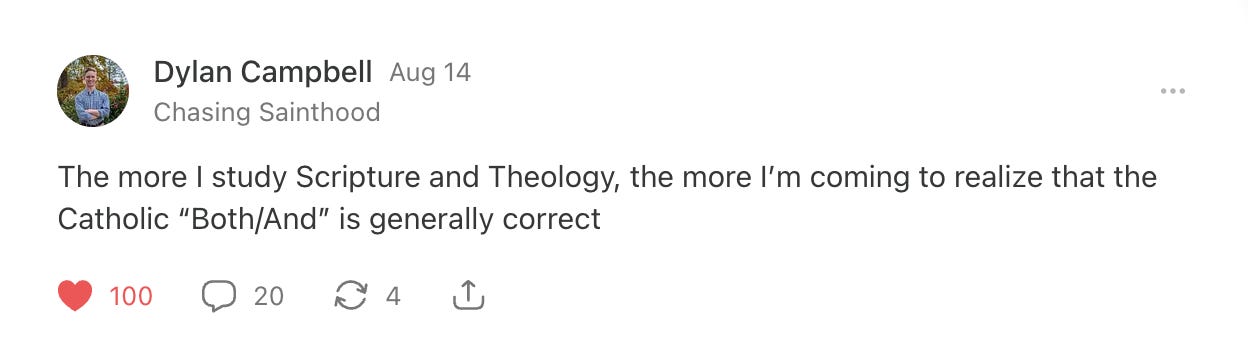
PS—As an honorable mention, hands down my favorite note of 2025, from Dylan Campbell:
Thank you for taking the time to put this together! I love your recommendations and saved several articles throughout to read when I get the chance. I totally agree that this is the “finer things” club. It’s a treasure here. For years I was in the social media world—mostly to lead to my writing—but it is, for the most part, a toxic wasteland. I left for a few years, and came back to find it has only gotten worse. Of course, there are little treasures you can find here and there, but with SS, I always leave rejuvenated and inspired. The hardest part is logging off simply because I could get lost in it for a while! (So much goodness to explore here.) Thanks again for this post. Much appreciate your recommendations!
I'm so glad that you made the decision to join us here on Substack, Matt. I'm glad that you've been able to find a like minded community of writers/readers who share your passion for the Catholic both/and. I'm hoping that this year to have a more focused Substack strategy myself.